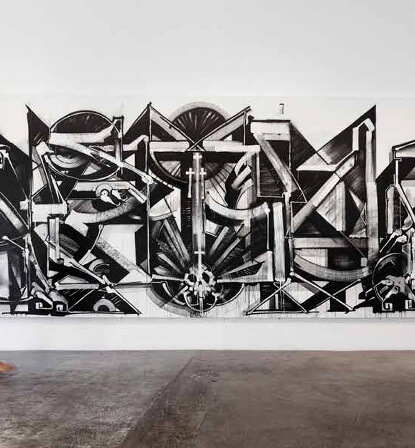
The artist has always considered his work a form of poetry — not the kind found in books, but the kind seen on walls. Each piece carries a rhythm: the way the characters stack, the space between them, how they breathe together. That is no different than verses on a page. The distinction is that RETNA invented the alphabet. Most writers work with letters someone else gave them. He built his from scratch, from pieces of Arabic, Hebrew, Egyptian, Gothic — whatever spoke to him. When he writes on a wall, he is not merely making words. He is deploying a language that exists only in that moment, on that surface. Consider the piece in the image — the skull, the cross, the way the lines radiate outward like light. That is a poem about mortality and transcendence. You do not need to read the symbols to know that. The composition tells you. Before writing was functional, it was magic. Marks on a wall that carried meaning beyond themselves. That is what the artist continues to do.
