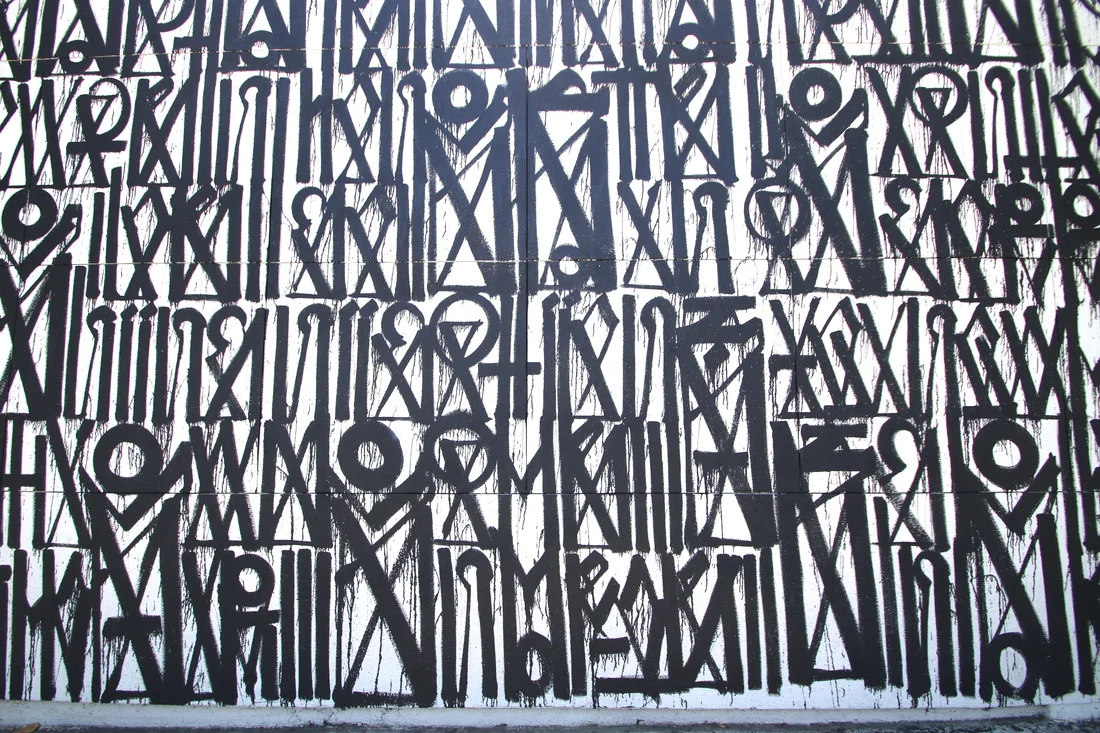
The San Francisco Opera commissioned RETNA to design the sets for Verdi's Aida, set in ancient Egypt. The directive was specific: not imitation hieroglyphs, but his actual script — the alphabet he has spent a lifetime refining. He accepted before fully weighing what it would entail.
The result was a series of massive panels in black, gold, and white that enveloped the stage. The symbols carried the weight of temple inscriptions, as though carved a millennium ago, yet they stood in a modern opera house. Depending on the seat, the light played differently — letters retreating into shadow in one moment, surging forward in the next.
The same visual language translates across contexts — from an opera stage to the urban wall shown here. RETNA's script occupies whatever surface it touches with equal authority. The Washington National Opera later adopted the same Aida production. Two cities, one alphabet. Audience members said they had never seen the opera rendered this way. Even before the music began, the writing on the walls stirred something. This is the nature of his calligraphy — it requires no translation. It is felt or it is not. And in that room, with Verdi's score filling the space, it was felt.